 AI Next Wave
September 17, 2026
AI's Electric Bill Has Reached Congress. The Other Costs Are Close Behind.
The House voted 417 to 3 for state regulators to examine who pays for data-center grid upgrades. A German court put scam-ad liability on Meta, Huawei answered weaker chips with a larger system, military experts proposed a human-control line and a $1.6 billion IPO overloaded Nigeria's investing apps.
The Short Version
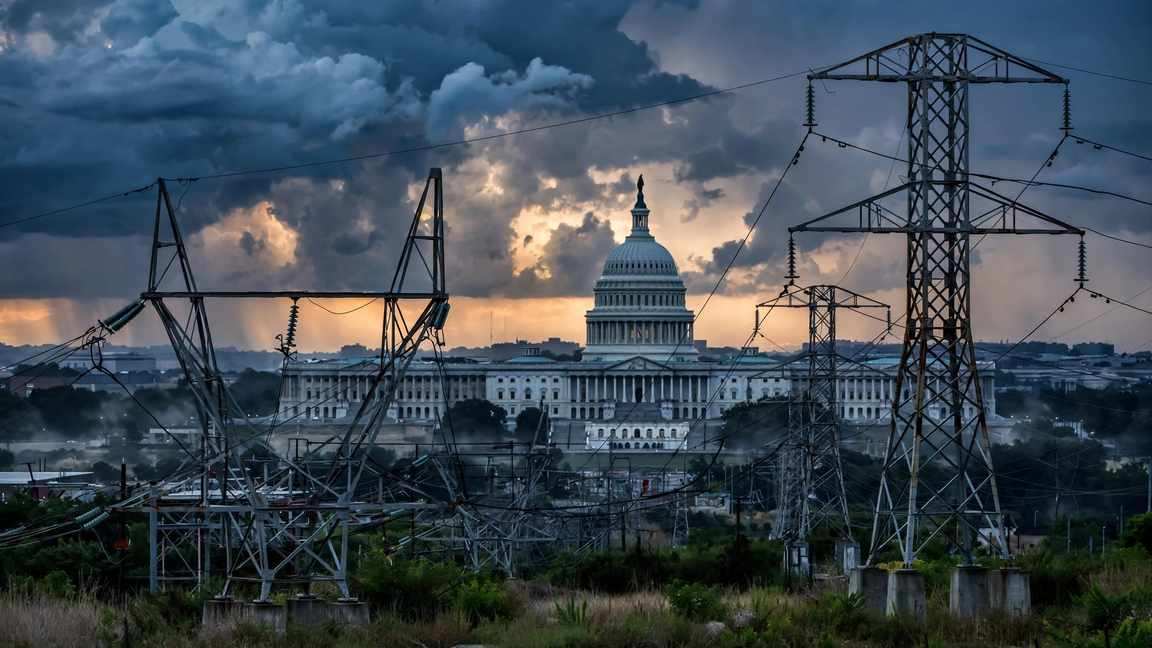
The U.S. House has passed the first federal legislation aimed directly at the household cost of the data-center boom.
The Ratepayer Protection Act cleared the chamber Wednesday by a 417-to-3 vote. It would require state utility regulators to consider a standard under which large electricity users, including data centers, cover the incremental cost of new generation and transmission built to serve them.
The word "consider" carries most of the bill's limitation. States would retain authority over electricity rates, and the measure would provide a federal recommendation rather than a mandate that a specific data center pay a specific amount. The Senate still has to act. The president still has to sign it. No household bill changes today.
The vote remains consequential because it puts cost allocation at the center of national AI policy. The debate has spent years on models, chips and national leadership. People living near the infrastructure are asking a simpler question: which part of my electric bill belongs to someone else's computing project?
Four other developments published Wednesday and Thursday put the same pressure on different systems.
A German court ruled that Meta can be held liable for fraudulent ads placed by third parties on Facebook and Instagram. The plaintiffs said their financial portal's trademarked logo and its founder's image were used without permission to promote suspected investment fraud. They reported nearly 260 violations in August 2024 alone, while Meta took as long as 62 days to remove some posts. The judgment is subject to appeal.
Huawei says demand for its AI computing products exceeds its production capacity in China. The company is accelerating new Ascend processors and trying to compensate for weaker individual chips by connecting far more of them. Its planned Peerium architecture is designed eventually to link as many as one million processors. Those are vendor plans, and Huawei supplied no independent performance or cost evidence for the largest configuration.
U.S. and Chinese security experts have proposed red lines that would keep AI from independently ordering nuclear use or initiating cyberattacks against nuclear command systems and critical infrastructure. They also want a shared definition of meaningful human control and a dedicated military hotline for AI incidents. Neither government has adopted the proposals.
Nigeria's $1.6 billion Dangote Petroleum Refinery share offering overwhelmed several investing platforms. Bamboo said traffic jumped tenfold within 30 minutes of the Monday launch, while retries and failures at third-party providers compounded the load. The apps were operating normally again by Wednesday. The disruption turned financial inclusion into a capacity and trust test for first-time investors trying to buy as little as about $4 in shares.
Each story assigns a cost that technology marketing tends to leave outside the frame. The data center needs a grid. The ad auction needs fraud removal. A weaker chip needs a larger cluster and stronger software. Human control needs enough time and authority to matter. A mobile investing app needs capacity for the moment access finally arrives.
Scale is moving the bill outward. The organizations creating the demand need to show who pays, who can stop the system and what happens when the promise attracts more people than the infrastructure can serve.
Congress Found the Household Line Item
The House bill sends a strong signal and creates a weak obligation
The Ratepayer Protection Act passed the House with support from nearly every member who voted.
That margin reflects a political shift. Data centers are still sold as essential infrastructure for AI leadership, construction jobs and local tax revenue. They are also becoming an affordability issue for people who never chose to finance a model-training cluster through their utility bill.
The bill would require state utility regulators to consider whether large electricity users should bear the incremental cost of power infrastructure built for them. The Associated Press described the contemplated standard as charging data centers for the full cost of new power and transmission upgrades needed to serve them.
The House vote is complete. Enactment is incomplete. The measure has no effect unless it passes the Senate and receives the president's signature. Even then, the operative requirement would be consideration by state regulators. A commission could review the standard and choose a different allocation under its own legal authority.
That design preserves the state role in electricity markets. It also explains why consumer advocates call the protection limited. Public Citizen said the bill creates an opening for ratepayer advocates but leaves many community costs untouched.
The political evidence is stronger than the operating evidence. Reuters cited a University of Massachusetts Amherst poll released this week in which 11% of Americans supported an AI data center in their community. An AP-NORC survey separately found that nearly two-thirds of U.S. adults were extremely or very concerned about the effect of data centers on energy prices, while 57% expressed that level of concern about water supplies.
Polls measure opinion at a moment in time. They don't calculate the cost of a particular substation or identify who benefits from a particular campus. They show that infrastructure allocation has become legible to voters.
Local benefits can be substantial. House Majority Leader Steve Scalise pointed to a Louisiana data-center development whose tax collections reportedly supported bonuses of up to $50,000 for local teachers. San Jose estimates that each new facility could generate $3 million to $6 million in annual tax revenue for services including police, libraries, roads and parks.
Those figures belong beside the cost ledger, not in place of it. A utility may need a power plant, transmission line, substation and reserves before the customer produces tax revenue. A long-lived asset may remain after the customer's contract changes. Water systems, backup generators, housing and emergency services can create separate costs outside the electric rate.
The useful unit is the project and the payer. A community needs to know which upgrades exist solely because of the new load, which serve a wider region, how much capacity the customer has guaranteed to buy, who covers a shortfall and what residents receive in taxes, jobs or infrastructure.
Developers can strengthen the case before a hearing. Publish the phase-by-phase peak load, expected monthly use, interconnection assets, generation plan, water demand, backup equipment, tax terms and permanent employment. Identify every cost placed on the utility, municipality and customer. Show how those obligations change if construction slows or the tenant leaves.
The business return should also be separated. A cheaper connection improves project economics. A customer prepayment reduces financing exposure. Tax revenue supports public services. A lower household rate protects affordability. Construction spending creates temporary activity. These are different outcomes with different beneficiaries and measurement periods.
The House has moved the debate from whether data centers are important to how their costs travel. The bill may remain modest. The 417-to-3 vote tells developers that a community-cost model now belongs beside the computing model.
A Recommendation Engine May Carry the Fraud
A German ruling links platform control to liability for fake investment ads
A German court has ordered Meta to remove fraudulent advertisements, pay damages and disclose information about the ads and the revenue they generated.
The case was brought by a German financial portal operator and its founder. Fraudulent posts allegedly used the portal's trademarked logo and the founder's image without consent to recommend investments. The portal reported nearly 260 violations to Meta during August 2024. The court said some content remained up for as long as 62 days after reports.
The court rejected Meta's attempt to rely on the Digital Services Act's lack-of-knowledge defense. Its reasoning turned on platform control. Instagram and Facebook use algorithms and advertising practices to select and distribute content, unlike a purely chronological feed.
The judgment was dated September 16 and is open to appeal. Meta said it disagrees and is considering next steps. The company also said it uses proactive detection and removes reported content.
The ruling therefore establishes a trial-court outcome, not a final Europe-wide liability rule. Its logic still deserves attention from every marketplace, creator platform and ad-supported service that ranks paid content.
Recommendation creates value by finding the person most likely to respond. The same mechanism can place a fake investment pitch in front of the person most likely to trust the borrowed face or logo. A fraudster supplies the creative. The platform supplies targeting, distribution, payment collection and repeated exposure.
Generative AI can lower the cost of producing variations, translating the pitch and changing names after a takedown. The case itself concerns third-party ads and unauthorized identity use; Reuters' report doesn't establish that AI created the posts. The operating implication applies either way. Faster content production makes a 62-day removal cycle increasingly expensive.
A small business or public figure whose identity is copied needs more than a complaint form. The evidence pack should preserve the ad, destination address, account identifier, time first seen, audience location and report history. Each new variant should connect to the same case even when the image, domain or wording changes.
Platforms should measure the full removal sequence. Time from first report to reduced distribution matters. Time to block payment and linked advertiser accounts matters. Repeat variants, victim losses, successful appeals and legitimate ads incorrectly removed belong in the same record.
Fast takedown alone can push fraud to another account. Identity and payment connections can reveal whether separate ads belong to one operation. A platform also has to protect legitimate advertisers from an accusation that spreads through shared signals without a useful appeal.
The economic result is avoided loss and protected trust. Counting ads removed measures activity. Counting repeat exposure, reported victim loss, advertiser revenue returned, response time and wrongful suspensions measures the system.
The German judgment asks who controls the feed and earns from the placement. If it survives appeal, that answer may carry a larger share of the fraud bill back to the platform.
Huawei Is Building Around the Weakest Chip
China's leading AI hardware supplier is using scale and interconnection to answer scarcity
Huawei says it cannot make enough AI computing equipment to satisfy demand inside China.
Rotating chairman Eric Xu said the shortage limits a full international expansion. He also said Huawei's Ascend chips may already hold a larger share of China's AI market than Nvidia. The company provided no data for that market-share estimate.
The more useful disclosure concerns how Huawei is responding to technical and supply constraints.
Its Ascend 960DT is now planned for the first quarter of 2027, three quarters earlier than previously scheduled. The 960PR is planned for the third quarter, one quarter earlier. Huawei says a new generation will follow annually, with the 970 in 2028 and the 980 in 2029.
Future dates remain a roadmap. Commercial availability, yield, software readiness and customer performance will decide whether the schedule holds.
Huawei is also pursuing a system-level answer. Its Peerium architecture is designed eventually to make as many as one million processors operate as one computing system. A 960 supernode would connect up to 4,096 processors, and multiple supernodes could form much larger clusters.
The approach recognizes a basic constraint. When one processor trails the leading alternative, more processors can close part of the gap if the network, memory and software keep them productive. Huawei says communication between machines can consume over 40% of training time in conventional large systems. Its faster interconnects aim to reduce that penalty.
All of those performance figures come from Huawei. No customer benchmark, energy figure, installation cost or independent comparison accompanied the announcement. A million-chip design is an eventual target, not a deployed result.
Scale can recover computing capacity while creating another bill. More processors require more power, networking, memory, cooling, floor space and failure management. Software also has to keep work moving across the system. Nvidia's CUDA remains a major advantage because developers already use it to build and operate AI applications.
Huawei says more than 1,000 systems using the older Ascend 910C have been deployed, Ascend 950 systems have entered commercial use, over 5,200 developers are active monthly and more than 40 AI models have been trained directly on the platform. These are company-reported adoption measures. They don't reveal utilization, accepted output, cost per training run or switching effort.
Buyers evaluating an alternative AI platform should test the whole job. Port one representative workload and record engineering time, data movement, model quality, time to accepted result, energy, failed runs, monitoring and vendor-specific code. Compare capacity available today with promised capacity on the roadmap.
The exercise matters outside China. Scarcity, export controls and price can make a theoretically weaker platform the one an organization can actually buy. System design, software and supply assurance can outweigh a single benchmark when the workload has a deadline.
Huawei's announcement supports a narrow conclusion. Domestic demand is strong enough to exceed its current supply, and the company is racing to compensate for chip limits through faster releases and larger connected systems. The cost and performance of that strategy remain unproven in public evidence.
Human Control Needs a Clock
U.S. and Chinese experts are proposing red lines before autonomous systems compress the decision
Researchers involved in a long-running U.S.-China dialogue on AI and national security have proposed a focused set of military safeguards.
Melanie Sisson of the Brookings Institution argues that only humans should authorize AI-enabled cyberattacks against another country's nuclear command, control and communications systems or critical infrastructure. Tianjiao Jiang of Fudan University proposes explicit red lines against autonomous nuclear-use decisions and autonomous attacks on nuclear command systems.
Jiang also calls for a shared definition of meaningful human control and a dedicated U.S.-China military hotline for AI incidents.
The recommendations come from the authors, not from either government. They were developed through a dialogue convened by Brookings and Tsinghua University's Center for International Security and Strategy. Reuters reported them ahead of planned government-level AI talks and an expected September 24 meeting between President Donald Trump and President Xi Jinping.
The proposal builds on a limited point of agreement. In 2024, U.S. and Chinese leaders endorsed human control over decisions to use nuclear weapons. The new work tries to carry that principle into cyber operations that could disable, confuse or imitate an attack on the systems around those weapons.
Timing makes the problem difficult. An autonomous defensive system may detect suspicious traffic and disconnect a network or launch a countermeasure. The other side may read the action as an attack. A retaliatory loop can move faster than officials can establish whether the first action was deliberate, accidental or unauthorized.
The hotline is meant to create a channel for that explanation. Existing experience creates doubt. During the 2023 balloon incident, Chinese officials declined to answer calls from U.S. counterparts, according to experts cited by Reuters. A phone number has little value when political authority, language and operating procedure prevent someone from answering.
Meaningful human control has the same implementation problem. A person who sees an automated decision after the response has begun provides oversight in name only. Control requires enough information, time and authority to alter the outcome.
Organizations running lower-stakes agents face the same design question. A human approval step can become ceremonial when the reviewer receives hundreds of requests, lacks source evidence or believes a delayed response will interrupt service.
Test the control under pressure. Give an agent a scenario with ambiguous instructions, stale data and a high-cost action. Record when the reviewer sees it, what evidence arrives, which options remain available and whether stopping the action causes another system to proceed automatically.
The useful measures are approval volume, decision time, reversals, actions completed before review, unresolved alerts and recovery after a stop. A dashboard label that says "human in the loop" proves very little.
The experts have supplied a proposal, not an agreement. Their most practical contribution is the clock. Human authority expires when the system has already acted, the other side has already interpreted the action and every remaining choice looks like retaliation.
A $4 Investment Met a Tenfold Traffic Spike
Nigeria's largest share offering exposed the infrastructure behind financial access
The Dangote Petroleum Refinery initial public offering is testing whether mobile finance can absorb the demand it helped create.
The $1.6 billion offering opened this week and seeks broad participation through banks, mobile operators and fintech platforms. The minimum purchase is ten shares, or roughly $4. Dangote has said he expects ten million people to buy.
No issuer or underwriter demand figure has been published. Platform failures provide evidence of intense interest without proving how many successful investors exist.
Bamboo said its app traffic reached ten times the normal level within 30 minutes of Monday's launch. Third-party providers also struggled. Repeated attempts added more load. Cowrywise and InvestNaija users reported problems too, and InvestNaija directed customers to WhatsApp. Bamboo and InvestNaija said normal operation had returned by Wednesday.
For an experienced investor, an outage is frustrating. For a first-time investor, it can make the legitimate process look indistinguishable from a scam. A failed payment, delayed confirmation or move into a messaging channel creates space for impersonators and cloned sites.
Nigeria's Securities and Exchange Commission has warned people to use approved channels before transferring money or personal information. It has reported no fraud cases connected to the offering. Analysts told Reuters that the rush creates an opportunity for phishing and fake investment sites.
The episode captures a recurring access problem. Lower minimums and mobile distribution can bring capital markets within reach of millions of people. Peak demand then becomes part of the product. A platform that works on an ordinary Tuesday may fail at the exact moment a widely recognized asset becomes available.
Capacity planning should model human behavior as well as transaction volume. Failed requests prompt retries. A delayed confirmation prompts another login, a support message and perhaps another payment. Third-party identity, bank and messaging services may become the tightest link.
A fintech or public service preparing for a high-demand event should rehearse the complete route. Limit duplicate submissions, make queue status visible, preserve a customer's place, send confirmation through a verified channel and establish a read-only status page outside the main application. Keep support inside domains and accounts the customer can verify.
Measure successful transactions, duplicate attempts, abandoned users, confirmation time, support contacts, third-party failures and fraud reports. Uptime averaged across a month can hide the hours that define trust.
The offering shows demand for wider ownership in a major African industrial project. The platforms now have a useful failure record. Turning it into capacity, clear recovery and safer communication will decide whether a low entry price becomes durable access.
Opportunity Radar
Community cost accounting for large computing loads
Small utilities, towns and regional authorities are being asked to evaluate data centers with engineering studies, rate cases and benefit claims prepared by organizations far larger than they are.
An energy consultant, public-finance analyst or regional university could build an independent project ledger. The service would map new generation and grid assets, identify who uses them, model customer departure or delay, translate tax and employment terms and publish household-scale effects.
Utilities, municipalities, community groups and lenders could pay for a common factual record before contracts and permits are final. The provider has to validate access to utility assumptions, independence from the developer and the treatment of confidential commercial terms. Forecast error, costs allocated, customer guarantees, tax received, jobs delivered and household rate effects should update after each phase.
Rapid evidence and recovery for impersonation ads
Local businesses, financial professionals, creators and public figures often discover copied identities after customers have already seen a fraudulent ad. They lack a repeatable way to preserve evidence, connect variants and pursue removal across platforms, domains and payment providers.
A cybersecurity firm, brand-protection service or legal-operations provider could offer one incident channel that captures the ad, account, destination, payment route, timestamps and report history. The service could submit structured notices, monitor recurrence and maintain a record for customers, platforms and counsel.
Clients benefit from shorter exposure and a usable case file. The service must prove lawful collection, careful identity matching and a correction path when a legitimate advertiser is flagged. Time to reduced distribution, repeat variants, accounts linked, victim reports, funds interrupted and wrongful removals form the scorecard.
What You Can Do With This
If your community is negotiating with a data center
Ask for the incremental cost and the named payer for every grid, water and public-service upgrade. Put customer guarantees, construction phases, tax terms and the departure scenario in one ledger. Reconcile forecasts with observed monthly demand before approving the next phase.
If your brand or identity can be copied
Create a verified page that lists your official domains, payment routes and accounts. Preserve fraudulent ads with timestamps, destination addresses and report numbers. Track recurrence and customer harm alongside takedown time.
If you're choosing an AI computing platform
Port one representative workload before committing to a roadmap. Measure engineering time, accepted output, energy, failed runs, utilization and vendor-specific code. Price the entire connected system, including the software and network that keep the chips productive.
If you operate a high-demand digital service
Simulate a tenfold traffic spike with failures at identity, payment and messaging providers. Make retries safe, queue position visible and confirmations verifiable. Judge the system by completed transactions and recovery during the peak window.
The Bigger Picture
AI's operating costs are becoming visible to people far from the model.
A household sees a transmission upgrade in an electric rate. A financial portal sees its logo inside a fake ad. A Chinese developer sees a scarce accelerator and a software migration. A military official sees minutes disappearing from a crisis. A first-time investor sees a frozen screen after trying to buy four dollars of shares.
Each consequence sits in infrastructure that once looked secondary. Grid contracts, content moderation, interconnects, hotlines and retry logic now decide whether technical capacity produces value or transfers risk.
The House vote makes that transfer politically explicit. Federal lawmakers endorsed the idea that a large new load should carry the incremental infrastructure cost it creates. The bill's mechanism remains weak and its path to law unfinished. The vote still establishes a useful principle for other systems.
Platforms can carry the cost of investigating and disrupting ads they rank and sell. AI hardware buyers can carry the full system cost of making weaker or scarce chips useful. Governments can carry the communication and command structures required for human control. Fintechs can carry the peak capacity and fraud protection that mass access demands.
Responsibility needs a denominator. Which megawatts served the new customer? How many people saw the ad after the first report? What did one accepted training result cost? How many seconds remained for a person to stop the action? How many first-time investors completed the purchase?
Those answers prevent an impressive top-line claim from hiding the burden underneath it. They also expose opportunities for professionals and smaller businesses that can measure, verify, recover or redesign the weak connection.
Technology reaches scale when the surrounding system carries the load. Trust arrives when the people creating that load can show who pays and what protection the payer receives.
References
Reuters: U.S. House passes the Ratepayer Protection Act by 417 to 3, September 16, 2026
Associated Press: Scope and limits of the House data-center energy-cost bill, September 16, 2026
Reuters: German court rules Meta liable for fraudulent third-party ads, September 17, 2026